
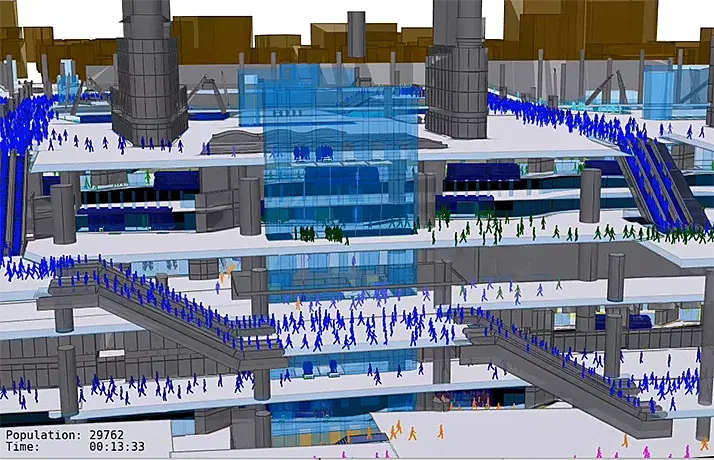
Pedestrian and evacuation modelling can help a team examine crowd movement, queues and evacuation scenarios. The analysis considers occupant numbers, route choices, response delays and assistance needs alongside the building geometry.
Circulation and emergency evacuation are different questions
A circulation study may examine congestion during everyday operation or an event. An evacuation study examines movement and response under defined emergency conditions. The same geometry can support both studies, but the population assumptions, routes, scenarios and performance criteria may differ.
For fire-safety analysis, distinguish required safe egress time from the time for which conditions remain tenable. SFPE guidance discusses the relationship between available and required safe egress time and the importance of human behaviour. Travel time is only one part of the overall assessment.
Occupant and route assumptions
- Expected occupant numbers and their distribution through the building.
- Familiarity with routes, likely response delays and staff instructions.
- Mobility characteristics and assistance arrangements relevant to the population.
- Door, stair and route availability for each scenario.
- Potential queues, merging flows and changes in route choice.
- The relationship between the evacuation strategy and other life-safety systems.
Route choice and assisted evacuation
In an assembly venue, occupants may be more familiar with the entrance than other exits. Sensitivity cases can examine the effects of different route choices and response patterns on queues and movement times.
Assisted evacuation is addressed through explicit assumptions about mobility, available assistance and the proposed procedures. These conditions form part of the model and the accompanying evacuation strategy.
Results and technical review
Results should identify where congestion occurs, what causes it and how proposed changes affect the outcome. Include appropriate verification, validation references and sensitivity discussion. The reported evacuation time is accompanied by the input assumptions, observed congestion and relevant limitations.
Where the model supports an alternative solution, establish the applicable code comparison and approval requirements. Modelling does not automatically replace prescriptive exit, accessibility or other obligations.
Operating conditions
Identify which conclusions depend on furniture layouts, staffing, access controls or event procedures. Preserve these conditions in the operating plan and review them when use changes. For BC and other Canadian projects, align the analysis with the local requirements and the actual building’s emergency strategy.
Noven’s services
For related project support, see our Pedestrian & Evacuation Modelling. Request a proposal for your project.
Related Insights
- Occupant Load Analysis: Why Floor Area Is Only the Starting Point
- Performance-Based Fire Design: What Makes a Model Useful?
Technical references
References reviewed October 23, 2026. Project requirements depend on the applicable code edition, jurisdiction and scope of work.